The Art You're Drawn to When You're Grieving — and Why

Art
soft geometric light from window cast as shadow on dark wall – light entering darkness, evoking the moment when image reaches what language cannot

Why certain works find us at specific emotional moments — and what that says about how we heal.

There is a painting you return to without quite knowing why.

Maybe it has been years since you first saw it — in a museum, in a book, on a screen at 2am when sleep had left you entirely. Maybe you don't think of yourself as someone who looks at art. But when something hard arrived, a loss, an ending, a grief that didn't have clean edges, you found yourself back in front of it. Standing still. Staying longer than you meant to.

This is not coincidence. It is not decoration.

The art we are drawn to when we are grieving is not random. It is a form of intelligence — the psyche finding what it needs when language has run out and logic has stopped being useful. Understanding why certain works find us in certain moments doesn't diminish the experience. It deepens it.

When Language Fails, Image Remains

Grief resists words. This is one of its defining features — the way it sits beneath the threshold of what can be said, expressed, or adequately explained to someone who is not inside it with you.

Art does not have this problem. A painting does not need to explain itself. A sculpture does not ask you to articulate your response before you're ready. Image, form, and color operate on a register that bypasses the part of the brain that needs things to make sense, and reaches, instead, the part that simply feels.

Neuroscientists studying aesthetic response have found that viewing art activates the same neural pathways involved in emotional processing and autobiographical memory. When we stand in front of a work that moves us, this is  not having an intellectual experience with emotional side effects. We are having an emotional experience that the intellect is invited to join, later, if it wants.

Grief works the same way. It is felt before it is understood. Art meets it there.

The art we reach for in grief depends on the nature of the loss. Raw, formless grief tends toward Käthe Kollwitz. Grief about identity or a changed relationship finds Frida Kahlo. Grief that needs beauty to be bearable reaches for Rothko. Grief about displacement or rupture finds El Anatsui.

The Works That Find Us

Not every work of art speaks to every grief. There is a specificity to what we reach for — and it tends to reveal something true about the nature of our loss and what we are quietly asking for.

When the grief is raw and without shape:

Close-up of bold black brushwork on white canvas — raw mark-making evoking the witness-bearing quality of art that meets grief without resolving it

We tend toward works that hold darkness without resolving it. Käthe Kollwitz — the German artist who lost her son in the First World War and spent the following decades making work about maternal grief, loss, and the weight of survival — is one of the most searched artists in the aftermath of loss. Her charcoal drawings and sculptures do not offer comfort in any conventional sense. They offer witness. They say: this is real, and it is terrible, and you are not wrong to feel it this way. For a grief that is still formless and overwhelming, being witnessed is enough.

When the grief is about a love that still exists but has changed:

Frida Kahlo's work finds people here — not because of its pain, though the pain is real, but because of its insistence on the self as both subject and survivor. Kahlo painted her own body, her own face, her own losses with a specificity that refuses generalization. She does not make grief universal. She makes it particular. For people mourning a relationship, an identity, or a version of themselves that no longer exists, that particularity is a kind of permission.

When the grief needs beauty to be bearable:

Mark Rothko's color field paintings — those vast, luminous rectangles of layered pigment — are among the works most frequently described as emotionally overwhelming by people who don't usually cry at art. Rothko himself said he wanted to paint basic human emotions: tragedy, ecstasy, doom. People in grief find him because he offers something rare: an aesthetic experience of emotional enormity that is also, undeniably, beautiful. He proves it is possible to hold both at once.

When the grief is about belonging and loss of home:

El Anatsui — the Ghanaian sculptor who creates vast shimmering installations from discarded bottle caps and metal fragments — speaks to griefs that are about rupture, displacement, and the making of something new from what has been broken. His work is made of fragments that were once separate and are now, together, luminous. For griefs about cultural loss, family fracture, or the experience of being between worlds, his installations offer something like a map back to wholeness — not by pretending the breaking didn't happen, but by insisting that beauty can be made from it anyway.

What We Are Actually Looking For

An open art book on a wooden surface with a lit candle glowing softly behind it — the solitary, intimate experience of turning to art in grief

When we seek out art in grief, we are not looking for answers. We are looking for three things, usually in this order.

Witness. The feeling that someone — the artist, the work itself — has been here before. That this darkness has been seen, held, and survived. Kollwitz gives this. So does Manchester by the Sea, one of the films we wrote about in our piece on films about love, grief, and human connection — a film that refuses to resolve its grief cleanly precisely because it understands that some losses don't. The work that witnesses us doesn't fix anything. It makes us less alone in the unfixable.

Permission. Grief comes with an enormous amount of social pressure to be moving through it, past it, and ideally almost done with it. Art grants exemption from this timeline. Standing in front of a Rothko that was painted seventy years ago, you understand that what you are feeling has always been felt. That it is not weakness or excess or self-indulgence. It is human. The work gives you permission to take the time the grief actually needs.

Beauty as proof. This is the most quietly radical thing art offers the grieving: evidence that beauty and pain are not opposites. That it is possible to make something of extraordinary loveliness out of the experience of loss — not by diminishing the loss, but by refusing to let it have the final word. This is what Wild Dark Shore understands at its core. What Charlotte McConaghy builds in that novel — is not a story in which grief is overcome. It is a story in which beauty is possible anyway. The best art offers the same thing.

The Museum as a Grief Practice

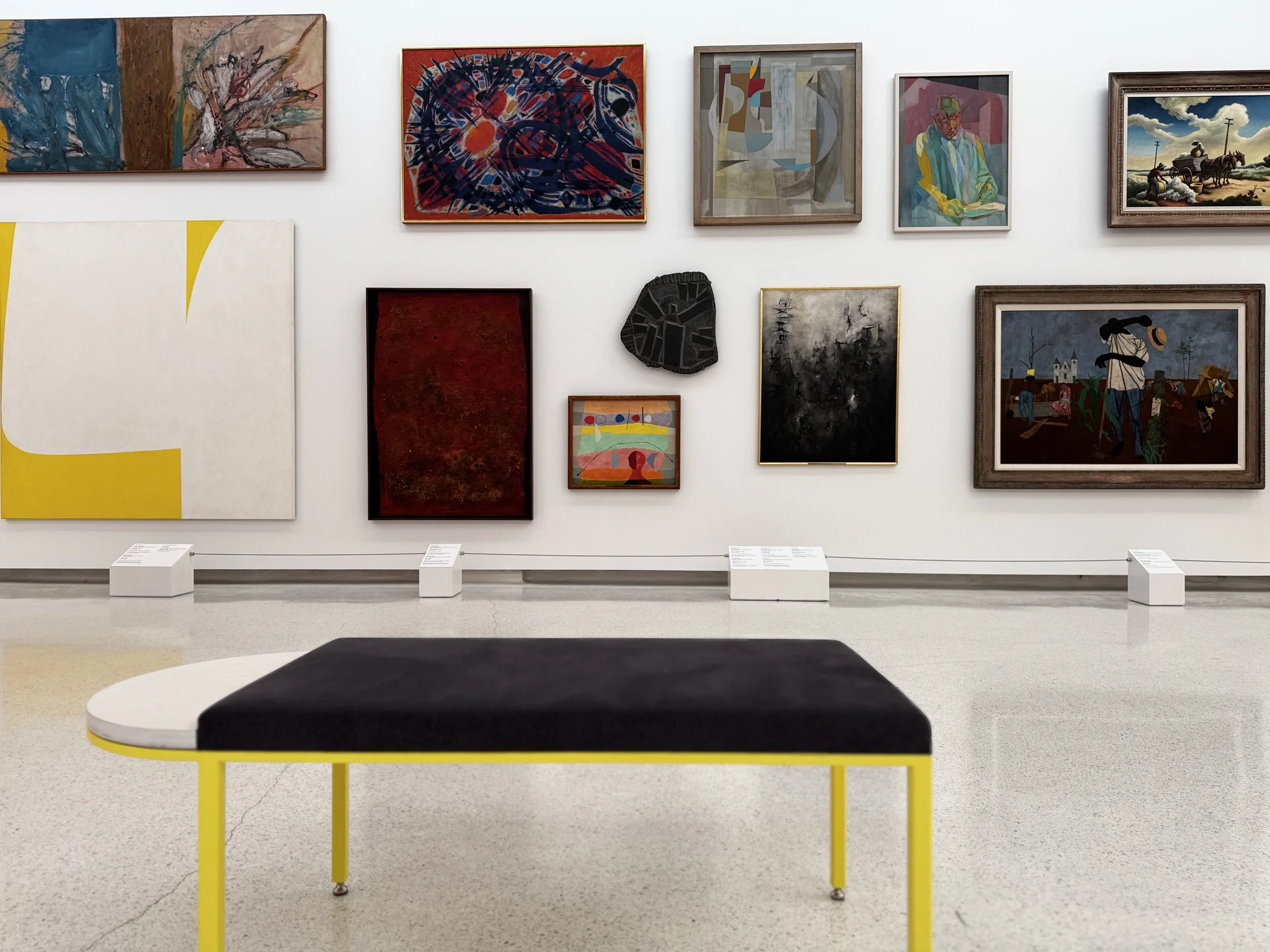
A museum gallery with a black-cushioned bench in the foreground and a wall of paintings behind it — an empty space for quiet presence

There is a reason that museum attendance rises in the aftermath of collective grief — after September 11, after the pandemic, after moments of cultural rupture and loss. People go, often without consciously knowing why.

They go because a museum is one of the few public spaces where it is acceptable to be still. Where no one will ask you what you're doing or whether you need something. Where you can stand in front of a painting for twenty minutes without explanation and the only thing required of you is presence.

This is not incidental. It is what museums, at their best, are for.

If you are in a season of grief — your own, or a shared one — and you have not stood in a gallery recently, consider it. Not as cultural enrichment. Not as self-improvement. As permission, simply, to be somewhere quiet with something beautiful, and to let whatever needs to arrive, arrive.

You don't need to understand the work. You just need to stay with it a little longer than feels comfortable. That is where it begins to do its work.

The Art Is Not the Cure

It bears saying: art does not resolve grief. It does not replace therapy, or time, or the difficult work of allowing yourself to be supported by the people around you. The shared meal we wrote about in our piece on the table as connection matters too. So does the book that sits beside you on the nightstand. So does the film that breaks you open in exactly the right place.

What art offers is something more specific and more modest: a form of companionship that does not require anything from you.
The painting is not tired of your grief. The sculpture does not need you to be better yet.
It simply remains — steady, present, and, if you have found the right work, exactly what you needed.

An open art book on a wooden surface with a lit candle glowing softly behind it — the solitary, intimate experience of turning to art in grief

FAQ: Art and Grief

Why do we seek out art when we're grieving?
Art reaches the brain's emotional and memory centres directly, bypassing the analytical filter. When grief resists language, image and form offer a way to feel and process without needing to explain.

What artists are most associated with grief?
Käthe Kollwitz, Mark Rothko, and Frida Kahlo are among the most frequently sought in grief — each for different reasons. Kollwitz offers witness, Rothko offers beauty alongside pain, and Kahlo offers the permission of specificity.

Does looking at art actually help with grief?
Art does not resolve grief, but it offers companionship, permission, and proof that beauty and pain are not opposites. Research on aesthetic response shows that viewing emotionally resonant art activates the same neural pathways as emotional processing itself.

Is going to a museum good for grief?
Museum attendance consistently rises after collective grief events. Museums offer one of the few public spaces where stillness is acceptable, and presence is the only requirement.


Further Reading & Watching


Next
Next

Black History Is a Living Blueprint