On pride, and a city where history remains part of everyday life.

Breakfast at Le Café de Paris is taken beside an open window full of flowers, while horse-drawn carriages roll past outside.
Quebec City is proud of itself and will tell you why, to anyone who asks. The story is odder than pride. The walls that make the city look most French were finished by the British, who took it in 1759.
The old city tells it first.
Within the Walls
Its French character is unmistakable, yet the city is not simply European in appearance. Quebec is the only fortified city north of Mexico, with nearly five kilometres of walls on a cliff above the St. Lawrence, inscribed by UNESCO in 1985. Champlain founded it in 1608 at a narrow point in the river, and its name is said to come from an Algonquin word meaning narrow place. The French began its defences, and the British completed them after the Plains of Abraham, and in the nineteenth century it took a British governor general, Lord Dufferin, to talk the city out of pulling them down.
The Citadelle, a British star fort finished in 1850, is still an active military base. Its regiment, the Royal 22e, is French-speaking. Stone façades line the narrow streets below it, street performers work the sidewalks, and the Notre-Dame de Québec Basilica-Cathedral rises nearby.
What the Convent Kept
In 1639, a widow from Tours named Marie Guyart, known as Marie de l’Incarnation, landed in Quebec to find a convent and a school for girls, French and Indigenous alike. She learned Algonquin and Iroquois well enough to compose dictionaries in them, and the letters she wrote to her son in France are an important source on early New France. The convent still stands in the Upper Town, its school the oldest institution of learning for women in North America. After the battle of 1759, the French general Montcalm was buried in its chapel by night.
Room at the Table
Traditional Québécois food sits easily alongside influences from elsewhere. At Pub St-Alexandre, poutine arrives with live music. Just outside the old city, Bistro La Cuisine has the ease of a gathering at home: laughter, cards at the table. At BoChica, a family-run Colombian restaurant, the same ease arrives from somewhere else.
Beyond the Walls
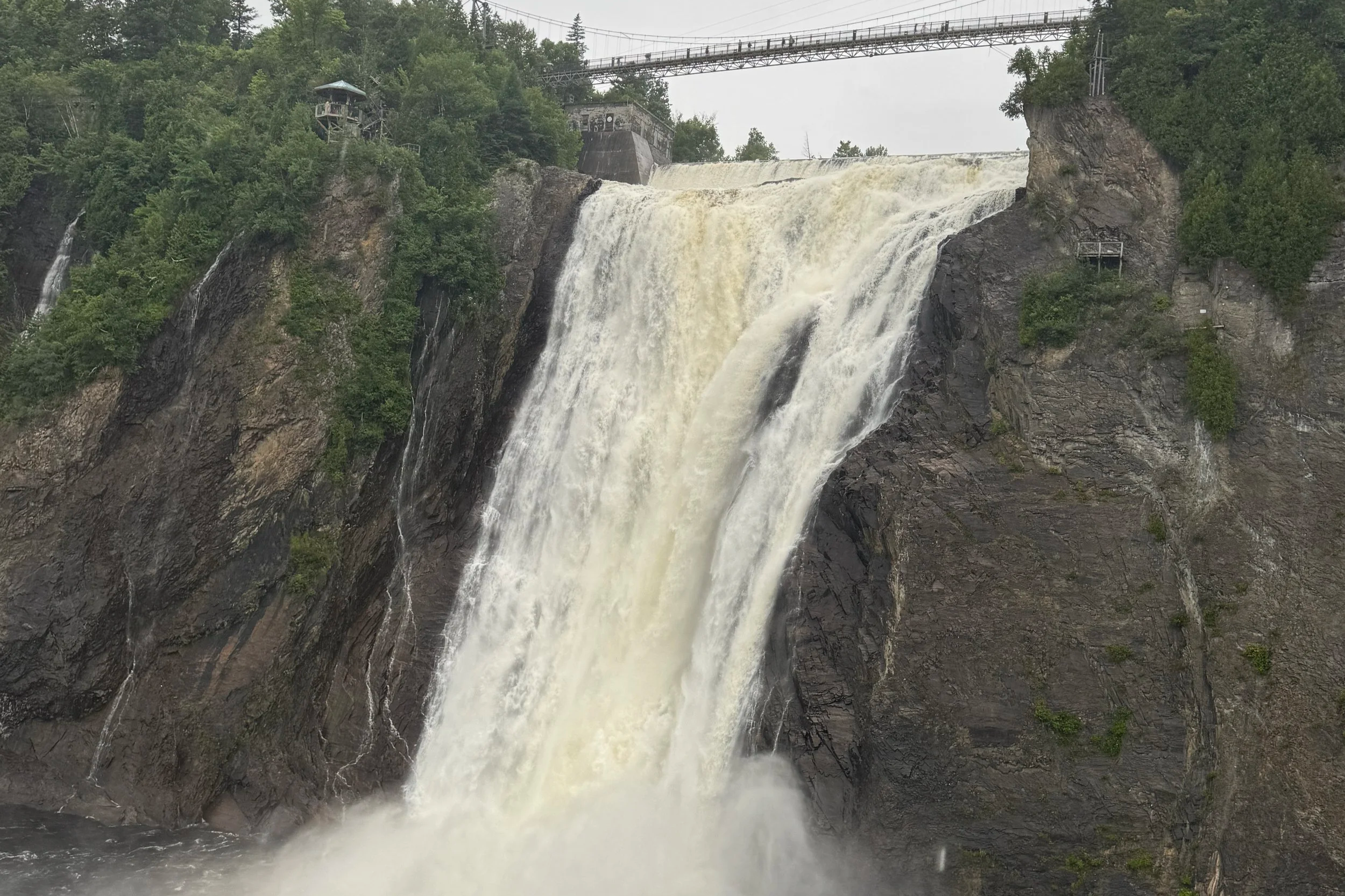
Twelve kilometres from the old city, Montmorency Falls drop 83 metres, thirty more than Niagara. A suspension bridge crosses the crest, and the river runs directly beneath it. Champlain named the falls in 1613 for the viceroy of New France.
Just beyond the walls, three words are inscribed on the façade of the Parliament: Je me souviens. I remember. It is the province’s motto, and the motto of the regiment that lives in the British fortress above. Ask anyone in the city what it means.
Further Reading: On Places That Keep Their Stories in Plain View
These pieces follow the same idea in different forms — that a place shows what it is by the stories it keeps in plain view.
→ Where History Is Still How People Get to Work: Another city whose walls still stand: Ferrara’s ring is a bicycle route, and the Renaissance is the commute.
→ A Town That Lives With 1692: Another place that lives beside the year it is known for, as Quebec lives beside 1759.