On a coast given away, and the town that grew up beside the gift.

Bar Harbor sits on the northeast shore of Mount Desert Island, the largest island in Maine, which the Wabanaki knew as Pemetic, the sloping land. The town was built to be a resort. What made it famous is what a handful of its summer residents decided to give away.
It begins on the Beehive.
The Beehive
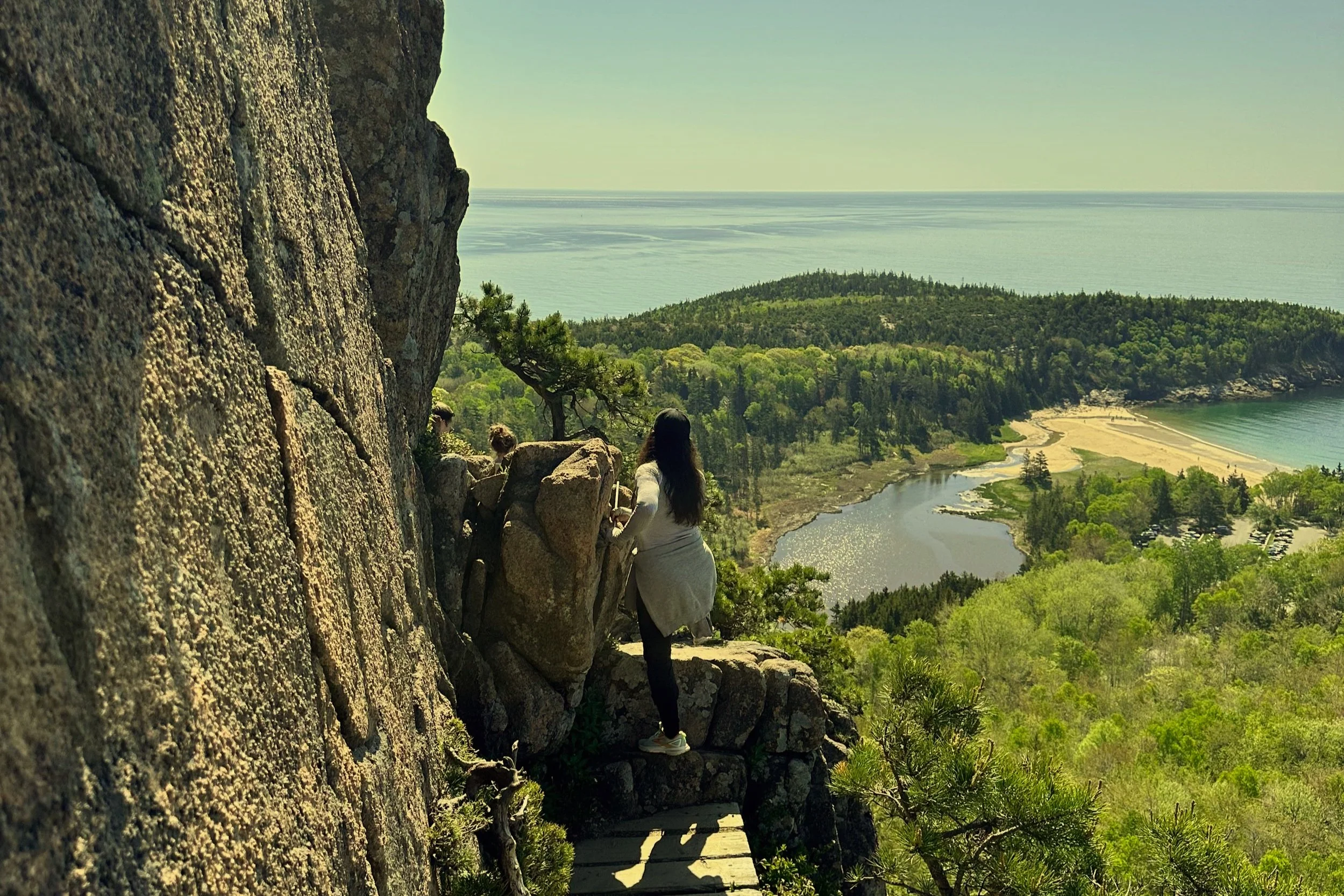
The Beehive is a short, steep climb up an exposed granite face, with iron rungs set into the cliff and narrow ledges above Sand Beach and the Gulf of Maine. It was laid out between 1912 and 1917 by Rudolph Brunnow, a summer resident who chaired the village improvement association’s path committee and gave some of his own money to build it. The Beehive and its neighbor, the Precipice, were popular at once and criticized at once: the crowds, some complained, were driving off the eagles that nested there. A path built by a village association, for pleasure, partly at a summer resident’s expense, is a fair summary of how Acadia came to exist.
What the Summer People Gave
The painters came first. In the 1840s and 1850s, Thomas Cole and Frederic Church painted the island’s surf and forested mountains, and the rusticators followed, then the hotels, thirty by 1880, then the cottages of the Astors, Vanderbilts and Rockefellers. In 1901, alarmed by development and the new gasoline-powered portable sawmill, George B. Dorr and others formed a trust to buy land and hold it. Dorr gave thousands of acres to the federal government and became the first superintendent of the first national park east of the Mississippi. John D. Rockefeller Jr. donated about a third of the park and built forty-five miles of carriage roads inside it, between 1913 and 1940.
Pemetic
The island was never empty. The Wabanaki, who have lived in Maine for more than twelve thousand years, came to Pemetic each season to fish, hunt, and gather berries and shellfish, and they made its first trails. Wabanaki guides took the rusticators out to the outer islands to hunt, and the park exists on that homeland. The Abbe Museum, downtown by the Village Green, keeps the story current, centered on contemporary Wabanaki art and voices.
The Fire
In October 1947, a fire burned nearly half of the island’s eastern side and destroyed sixty-seven of its two hundred twenty-two cottages. It finished what the Depression and the war had begun. The carriage roads are what remains of that era, and the town that rebuilt is smaller and looks outward.
The Town
What remains is a walkable harbor town of boutiques, galleries, and handmade jewelry, where the Bar Harbor Art Association’s walls still celebrate Acadia’s landscapes, as the first painters did. Dinner is Project Social Kitchen, tapas built around local ingredients and seafood, served under trees beside a fountain in candlelight. Lunch is Side Street Cafe’s lobster stew, and its chips and queso. In May the Atlantic is still cold enough to make wading a decision, and sunset over the harbor draws people to the shore. Whale-watching boats leave from the harbor for those with more time.
The view from the top of the Beehive, down to Sand Beach and open water, is the one a handful of summer residents gave away.
Further Reading: On Places Kept on Purpose
These pieces follow the same idea in different forms — that a place survives because someone decided it should.
→ Told to Anyone Who Asks: A city whose walls were nearly torn down and kept by one governor’s persuasion.
→ The City That Keeps Its Own Hours: A hill left alone while the modern city grew below it.
→ Where History Is Still How People Get to Work: A Renaissance plan still in daily use, five hundred years on.