On pace, and a hilltop city that has not hurried for the visitor.
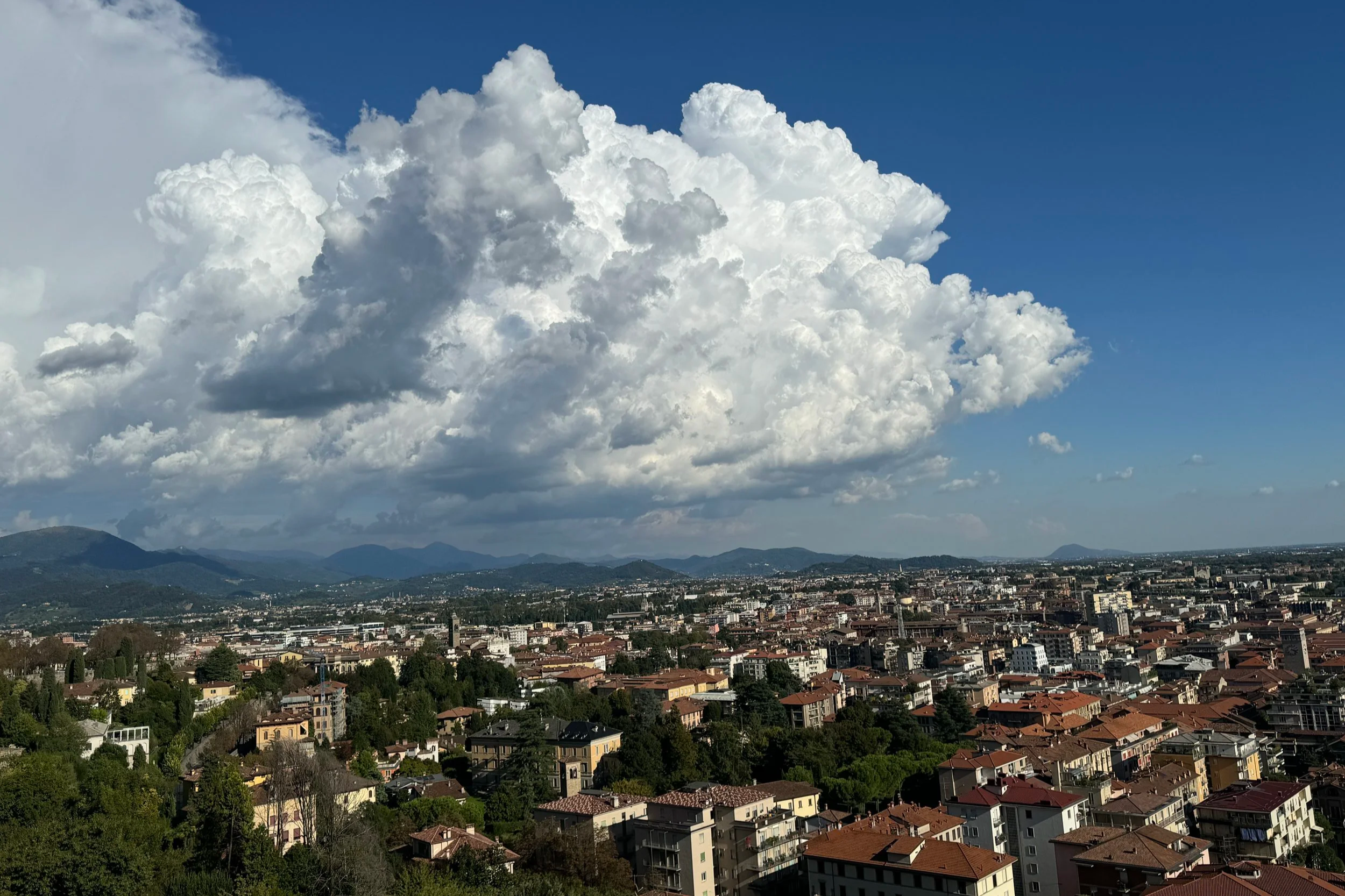
Bergamo is two cities on one hill. The lower one works: it has the station, the banks and the shopping streets, and it is less than an hour by train from Milan. The upper one is where the city began, before it spilled down into the plain, and it has not been in a hurry since. The modern city grew below, and the hill keeps its own hours.
Everything slows at the top.
Above the Plain

A funicular has joined the two cities since 1887. The engineer Alessandro Ferretti built it to run on steam, with two cars counterweighting each other up the slope, and it still passes through the walls themselves. Venice built those walls between 1561 and 1588, and UNESCO listed them in 2017. By most accounts, they were never besieged. Today, they form a six-kilometre walk above the plain.
Until the Bell

Piazza Vecchia is the Upper Town’s living room. The Palazzo della Ragione, Lombardy's oldest municipal seat, faces the Palazzo Nuovo, begun in the early seventeenth century and not finished until 1928, a building that kept its own hours, too. By evening the square fills with locals and travelers, and aperitivo stretches into the night: a wine bar, a local charcuterie platter, a glass of Franciacorta. A table for one is left alone.
At ten, the Campanone strikes a hundred times. The bell once told the city the gates were closing. The gates stopped closing long ago, and the bell kept the hour.
What the Hill Holds

The Corsarola, the Upper Town’s main street, runs from Piazza Vecchia to the Cittadella, built in the fourteenth century by the Visconti. Along the way, the twelfth-century basilica of Santa Maria Maggiore stands beside the Cappella Colleoni, the Renaissance chapel the condottiere Bartolomeo Colleoni built for his own tomb in the 1470s, all polychrome marble and carving. Donizetti, Bergamo’s own composer, is buried inside the basilica. The trails and lookouts of Parco dei Colli carry the city out into the hills.
Below, the Accademia Carrara hangs Botticelli and Raphael, and the Lower Town around Piazza della Libertà holds the everyday city: a lunch, a last gelato.
The Table
Casoncelli, Bergamo’s half-moon pasta, is filled with meat, crushed amaretti and raisins, and served with browned butter, sage and pancetta. The sweetness inside the savory is the whole idea. Stracciatella gelato, now familiar far beyond Bergamo, was invented here in 1961, at La Marianna, by Enrico Panattoni. The name means little shreds.
After Hours

When the crowds thin, the city has room for itself—and for conversation with the people who live there. Sunset from the Venetian Walls. A glass of Franciacorta in the piazza. At ten, the bell.
Further Reading: On Places That Keep Their Own Pace
These pieces follow the same idea in different forms—that a place shows its character in the pace it keeps.
→ Where History Is Still How People Get to Work: Another Italian city with a speed of its own: in Ferrara the bicycle is the native speed, and the walls are a ride.
→ The Cities That Reward Walking Alone: Bergamo again, among five cities best understood on foot, where the six kilometres of wall are the walk.