The Invisible Life of Addie LaRue by V.E. Schwab
On V.E. Schwab's The Invisible Life of Addie LaRue and the difference between being remembered and being known.
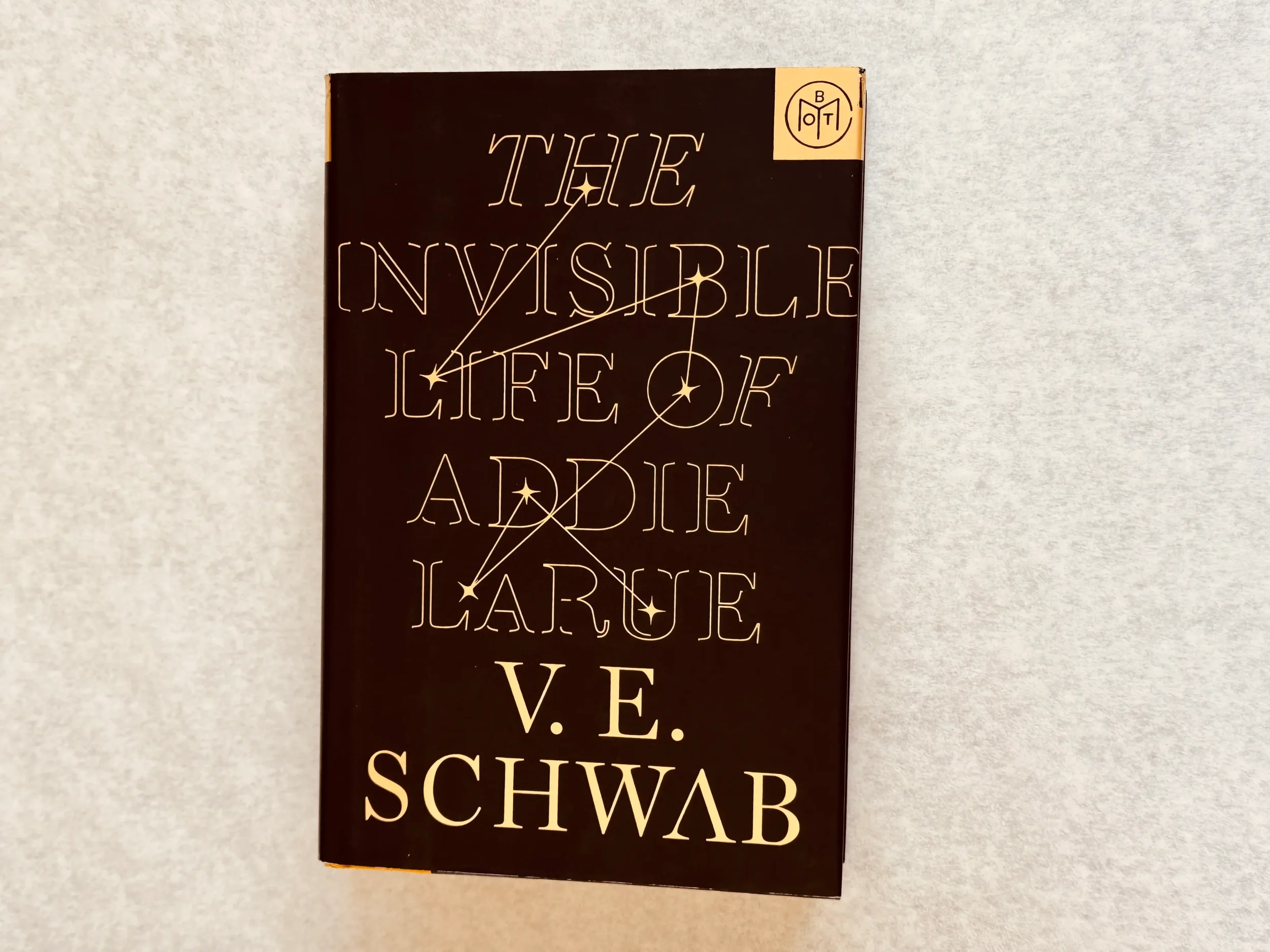
The Invisible Life of Addie LaRue Book Cover: Two curses, one dark god
In 1714, a young woman facing an arranged marriage makes a desperate bargain for freedom. She gets it—and with it, a curse. Addie LaRue will live forever, but the instant she's out of anyone's sight, they forget she exists. She can't say her own name aloud. Nothing she creates survives; paintings fade, photographs distort, her signature never dries on any page.
Three hundred years later, the price was still being paid.
A Curse of Total Absence
Addie's condition is not simply loneliness. It's the removal of evidence—no record, no trace, no proof she was ever in the room. She learns to survive centuries this way: falling in love with strangers who wake up believing they dreamed her, watching her own parents fail to recognize her face. The freedom she wanted from her small village life cost her the one thing freedom usually assumes: the ability to be known by anyone at all.
A Curse of Total Visibility
Three centuries later, in a New York bookstore, Henry Strauss makes his own desperate bargain with the same dark god—not for freedom, but to finally feel like enough. He gets it, too. Everyone who looks at Henry now sees exactly what they need him to be: the perfect son, the perfect partner, effortlessly beloved by strangers on the street. It should feel like everything he wanted. Instead, Henry realizes no one is actually looking at him—they're looking at whatever version of him the spell has shown them. His curse has a harder deadline than Addie's: love this completely, purchased this way, and all comes with only one year before his entire soul belongs to Luc.
Two people, cursed by the same god, with opposite problems. One is invisible no matter what she does. The other is seen but not truly.
The One Person Neither Curse Could Touch
When Addie meets Henry, something neither of their bargains accounted for happens. He remembers her. Having each struck their own deal with Luc, neither curse holds power over the other—Henry sees Addie exactly as she is, and Addie, immune to whatever spell governs how strangers see Henry, sees him the same way. For the first time in three hundred years, Addie becomes visible to someone.
It isn't rescue. It's recognition—the one thing both curses were specifically designed to deny them.
What Outlasted Both Curses
When Henry's deadline finally arrives, Addie strikes her own bargain: her permanent freedom, in exchange for his life. She vanishes into Luc's company, forgotten by the last person who had ever truly seen her.
What survives is not memory. Henry writes down everything Addie told him about her three centuries—and publishes it. The book carries the same title as the one you'd be holding if you picked it up: The Invisible Life of Addie LaRue. Neither a curse of invisibility nor a curse of false visibility could make either of them truly known. A story, deliberately written and given to strangers, did what three hundred years of survival alone couldn't.
Further Reading: On Being Known, Not Just Remembered
These pieces follow the same idea in different forms. Being truly seen and known are not the same; the difference is usually where a story's real weight lives.
→ What the Playlist Remembers: A different kind of story for what outlasts a moment—not a written record this time, but a song built to hold atmosphere the way this novel's ending holds a life.
→ The Water Family: The inverse fear—not a curse of being forgotten, but a family that refuses to claim someone at all, and the people who choose to remember her anyway.