What Margot Bujold Chose to Inherit
On a contemporary painter's declared debt to Marcelle Ferron, and the radical weight behind three quiet words: light, gesture, color.
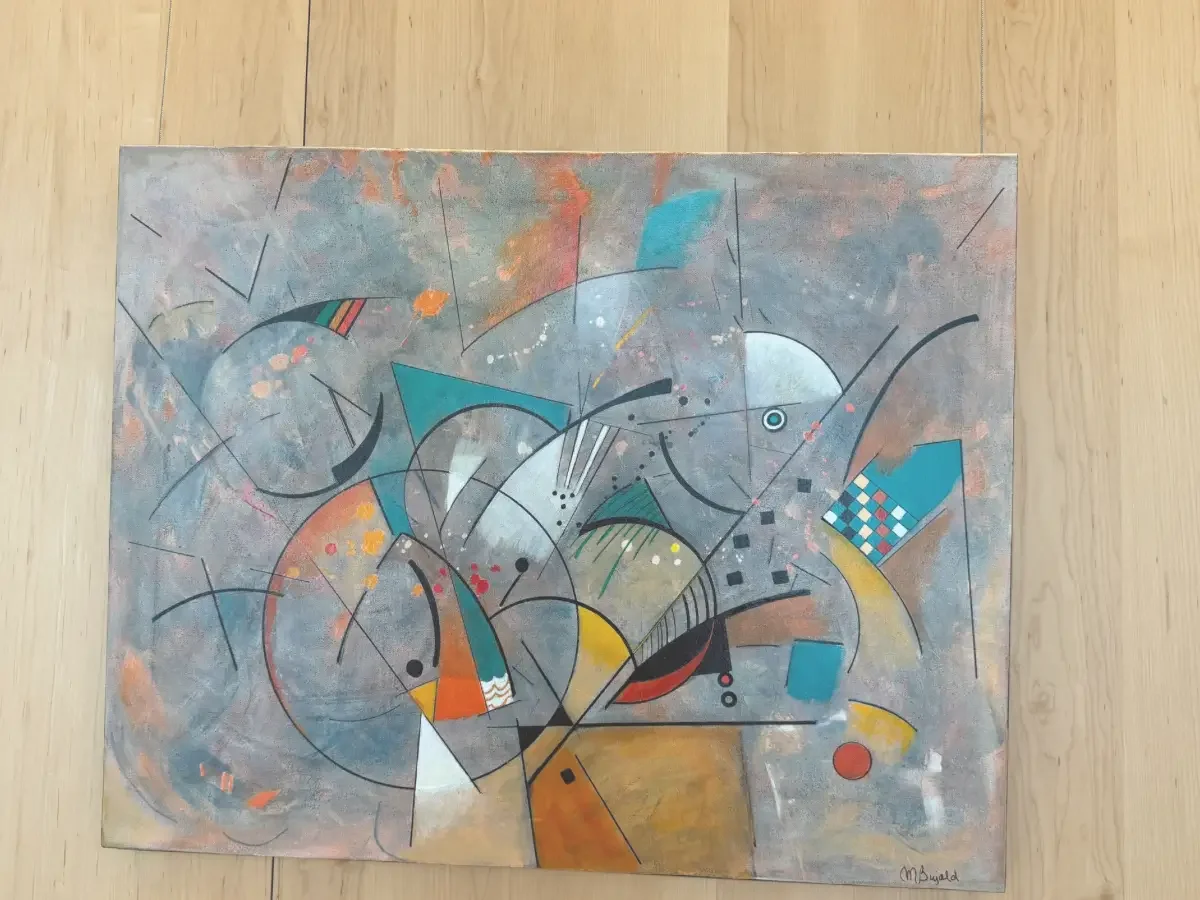
Margot Bujold - Sans Titre Acrylique
Beside a wall of paintings, a small card carries the artist's own explanation, in her own words: "Des œuvres de Marcelle Ferron, j'ai puisé la lumière, le geste, la couleur"—from Marcelle Ferron's work, I drew light, gesture, color. Margot Bujold is not claiming inspiration in the abstract. She's naming exactly who she's continuing.
What It Meant to Sign That Document in 1948
Marcelle Ferron was one of the signatories of Refus Global, the 1948 manifesto that denounced the religious and political suffocation of art and thought in Quebec—a document radical enough to cost several of its signers their jobs. Ferron spent the following decades proving the manifesto's argument with her own hands: thick, gestural paint applied straight from the tube, often with a palette knife instead of a brush, color handled as something to be fought for rather than politely arranged.
What "Light, Gesture, Color" Traces
Across her career, Ferron's own paintings moved from tumultuous, forceful bursts of color toward an increasing fascination with light itself, eventually drawing her away from canvas entirely and into stained glass, where color comes alive only when light passes straight through it. “Light, gesture, color” is more than poetic shorthand. It is the progression of Ferron's working life.
What Shows Up on Bujold's Own Canvases
Bujold's paintings hold both halves of that inheritance at once. Some pieces are pure gesture—ribbons of torn color, blue and red cutting across a pale ground, closer to weather than to composition. Others tighten into deliberate geometry: circles, triangles, a checkerboard fragment, with the logic of stained glass—color held inside firm lines and allowed to glow from within rather than sit on the surface.
Neither mode cancels the other out. Both are legible as the same inheritance, worked from two different directions.
What Gets Carried Forward
An artist naming her influence in three words is a small act. Choosing Marcelle Ferron specifically—a painter who helped force open what Quebec art was permitted to be is a much more significant gesture.
Decades later, someone is still drawing from that same well of light, gesture, and color. The manifesto asked for exactly that kind of continuation.
Further Reading: On What One Generation Hands the Next
These pieces follow the same idea in different forms — that influence, honestly declared, is a way of continuation, not imitation.
→ The Art We Call Craft—And Why the Line Was Never Neutral: A different fight over what counts as serious art, decades earlier and an ocean away.
→ What Amy Sherald Leaves Out: A different artist's formal choices, the same instinct to let a specific technical decision carry the full weight of an argument.