On crossing, and a city that does not raise its voice.
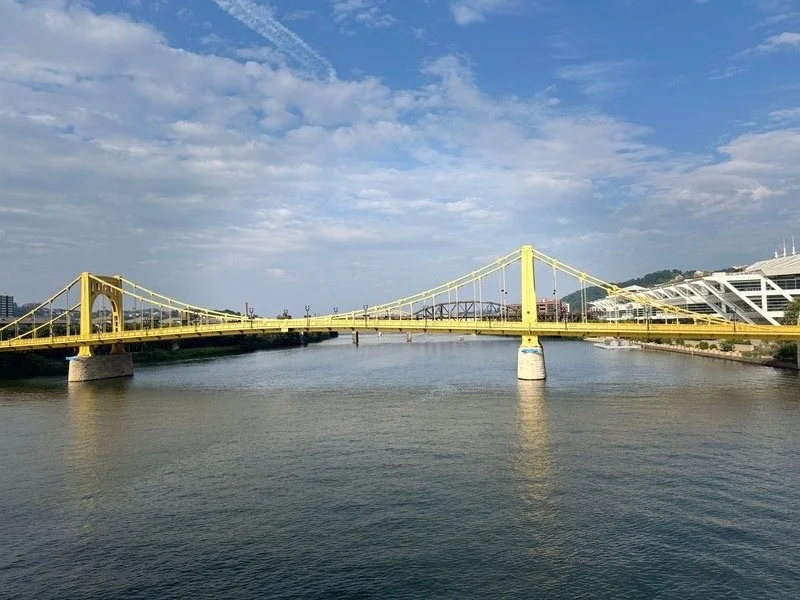
Roberto Clemente Bridge Pittsburgh. Iconic River Crossing in the Steel City
The Allegheny and the Monongahela meet in Pittsburgh and become the Ohio, and more than 400 bridges connect the city across the three.
Pittsburgh reveals itself one crossing at a time. Three of the bright yellow bridges between Downtown and the North Shore are named for Roberto Clemente, Andy Warhol and Rachel Carson: a ballplayer, an artist and a biologist.
The first crossing ends at Warhol.
Born and Raised
North of the Andy Warhol Bridge, the Andy Warhol Museum rises seven floors in a former warehouse, the largest museum in North America devoted to a single artist. On the fifth floor, a dark room holds two dozen silver pillows that drift down and are lifted again. Warhol himself was born in Pittsburgh, to Slovak immigrant parents.
Rooms Worth Staying In
The Carnegie Museum of Art and the Carnegie Museum of Natural History share a building, and a white marble Hall of Sculpture modeled on the Parthenon sits in it. Through a glass window between the dinosaurs and the gems, specialists clean fossils out of rock. Dippy, the Diplodocus, is named for Andrew Carnegie, who paid for the expedition that found it. A few rooms away, in the Scaife Galleries, hang the paintings of Mary Cassatt, who was born across the Allegheny when it was Allegheny City and spent most of her life in France. Henry Ossawa Tanner was born in Pittsburgh in 1859 and died in Paris. The city raises artists who leave.
The Frick Pittsburgh is quieter: Clayton, the Frick family’s own house; the art museum; and a car and carriage museum, all on five and a half acres in Point Breeze. The dinosaur is named for Carnegie, and the house belonged to Frick. Steel money is still on view.
A Table of Many Origins
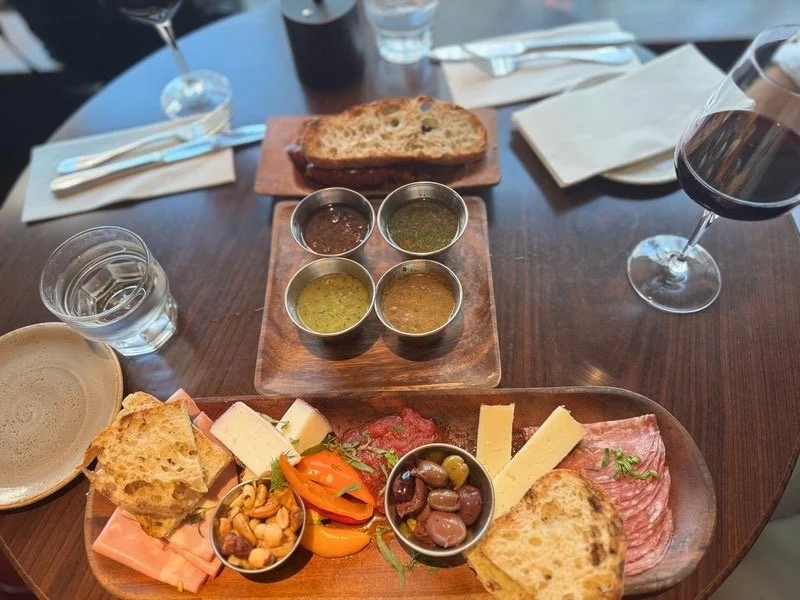
Pittsburgh Food Scene Gaucho Parilla Charcuterie Board and Wine.
Breakfast belongs to Pamela’s Diner, a local institution, and dinner to Gaucho Parrilla Argentina: a window seat, chorizo, a glass of Malbec. Arepittas, a Venezuelan favorite, and Nicky’s Thai Kitchen sit in the same city. The table holds the history of who crossed to get here.
Above the Crossings
Two inclines still climb Mount Washington, and one of them is a commute. The Monongahela Incline, open since 1870, is the oldest continuously operating funicular in the United States, and people still ride it to work. It was built for the mill workers who lived on the hill. The Duquesne Incline followed in 1877.
The car reaches the top. Three rivers below and the bridges across them.
Further Reading: On Cities That Do Not Announce Themselves
These pieces follow the same idea in different forms—that a city’s character shows in what it keeps in use, not in what it announces.
→ Where History Is Still How People Get to Work: Another city that keeps its past in daily use: Ferrara, where the walls are a bicycle ride as the inclines are a commute here.
→ The City That Keeps Its Own Hours: Another city that runs at its own pace, with a funicular joining its two halves too.
→ What Artists Know About Looking at Themselves (That the Rest of Us Forget): The self-portrait as a way of seeing, the same terrain of identity the Warhol Museum takes up.